Sir William Rowan Hamilton and the Discovery of Quaternions
(This article about the 19th Century Irish mathematician and astronomer Rowan Hamilton and his discovery of quaternions was written by Claude AI at my request. I have checked its sources and compared its account of Hamilton’s discovery with his own letter and the other sources that Claude provided. I’m not a mathematician, so corrections are welcome.)
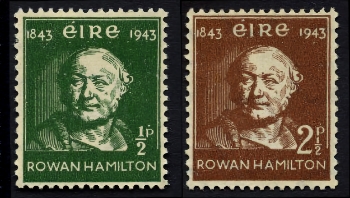
Sir William Rowan Hamilton (1805–1865) was an Irish mathematician, physicist and astronomer. He reformulated classical mechanics, predicted a new optical phenomenon, and on 16 October 1843 discovered quaternions, a four-part number system for describing rotation in three dimensions. Ireland marked the centenary of that discovery with two stamps in 1943.
Life and career
Hamilton was born in Dublin at midnight between 3 and 4 August 1805, and as a child prodigy was reported to have read Hebrew, Latin and Greek by the age of five. In 1827, while still an undergraduate at Trinity College Dublin, he was appointed professor of astronomy and Royal Astronomer of Ireland, and he lived at Dunsink Observatory until his death. In 1832 his mathematics of light led him to predict conical refraction, which Humphrey Lloyd confirmed by experiment. He was knighted in 1835 and was president of the Royal Irish Academy from 1837 to 1846. His reformulation of mechanics, now called Hamiltonian mechanics, later proved central to quantum theory, where the Hamiltonian describes a system’s total energy.
The problem of three dimensions
Complex numbers can be treated as points on a plane, and multiplying by i, whose square is −1, turns a point through a quarter circle. Hamilton sought a similar system for points in space and failed for years. He later recalled that in October 1843 his young sons greeted him at breakfast with “Well, Papa, can you multiply triplets?” He could only add and subtract them. A three-number system of this kind, it is now known, is impossible.
The discovery
On Monday, 16 October 1843, Hamilton was walking with his wife, Helen, from Dunsink Observatory to Dublin along the Royal Canal, on his way to preside at a meeting of the Royal Irish Academy’s Council. As they crossed Brougham Bridge, now Broom Bridge, in Cabra, he saw that he could multiply quadruples, though not triples. By his own later account, he could not resist cutting the fundamental formula into a stone of the bridge with a knife. Within an hour he had asked the Academy’s Council for leave to read a paper on quaternions, which he presented on 13 November 1843.
The equation
The formula Hamilton carved reads i² = j² = k² = ijk = −1: three imaginary quantities, each of which multiplied by itself gives −1, and whose product in order is also −1. A quaternion has four parts, a + bi + cj + dk. Its multiplication is unusual because order matters: ij = k, but ji = −k. Rotations behave the same way. Turn a book a quarter turn about a vertical axis and then a quarter turn about a horizontal one, and it ends up facing a different way than if the turns were made in the opposite order. A quaternion of unit size can therefore represent a rotation in space. The French mathematician Olinde Rodrigues had described the algebra of rotations in 1840, and Hamilton discovered it independently.
Later history and uses
Hamilton devoted the rest of his life to quaternions. From the mid-1880s the simpler vector analysis of Gibbs and Heaviside began to displace them in physics, borrowing freely from them. Quaternions have since returned as an efficient way to handle rotation without gimbal lock, the loss of a degree of freedom when two rotation axes align. They are used in computer graphics, robotics and orbital mechanics, and spacecraft attitude control is commonly commanded in quaternions.
Commemoration
Hamilton died on 2 September 1865, aged 60. A plaque on Broom Bridge records his discovery, and since 1990 an annual Hamilton Walk on 16 October has retraced his route from Dunsink Observatory to the bridge.
Ireland’s 1943 stamps
Ireland issued a halfpenny and a twopence-halfpenny stamp, each bearing Hamilton’s portrait and the dates 1843 and 1943. A catalogue gives the issue date as 13 November 1943, the centenary of his first paper on quaternions to the Academy.
Sources
- History of quaternions (Wikipedia)
- Hamilton’s letters on the discovery (Trinity College Dublin)
- Hamilton’s research on quaternions (Trinity College Dublin)
- Springer: the discovery
- John Baez: Brougham Bridge
- Ó Cairbre, Hamilton walk (Maynooth)
- Britannica: William Rowan Hamilton
- Oxford DNB extract: Hamilton
- FSU Molecular Expressions: Hamilton
- StampWorld: Ireland 1943
Go to the Ephemeral Treasures home page