Box 28, Arenas Valley, NM — A tiny country post office played a big role in my youth (Part 2)
Olga Harper resigns, Joe Moore becomes postmaster
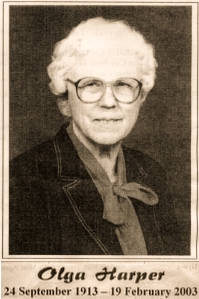
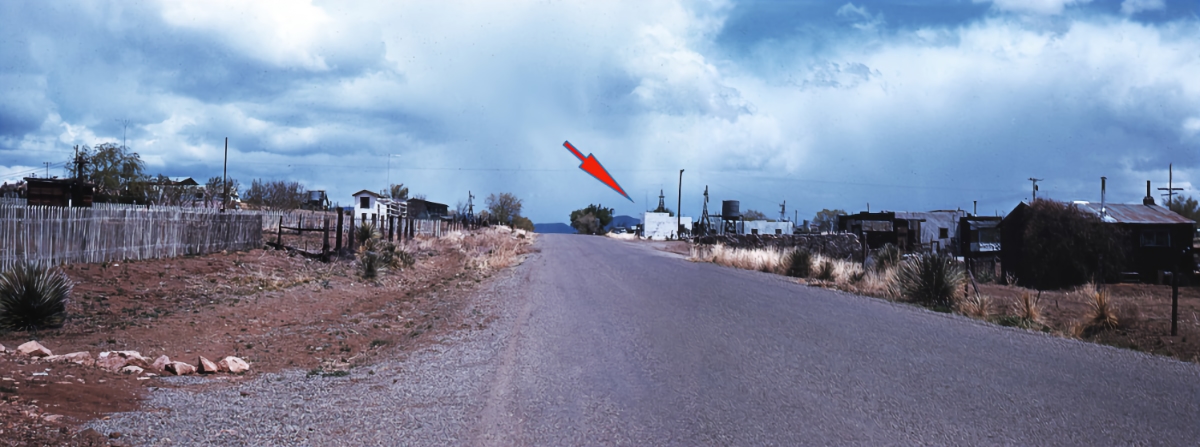
Five years after the opening of the Arenas Valley Post Office, Mrs. Harper resigned as postmaster and closed her convenience store. The post office was relocated to an old building just one lot to the east on the same side of Arenas Valley Road. Arenas Valley resident Joe Moore was named acting postmaster on April 30, 1952.
Both Olga and Joe had to jump through government hoops, filling out and signing the federal Bureau of Post Office Operations Form 971 to make the transition. The completed form confirms that the Arenas Valley Post Office was a small post office indeed, with a stock of stamps, postal cards, and stamped envelopes worth just $27.48, and $22.52 in cash.

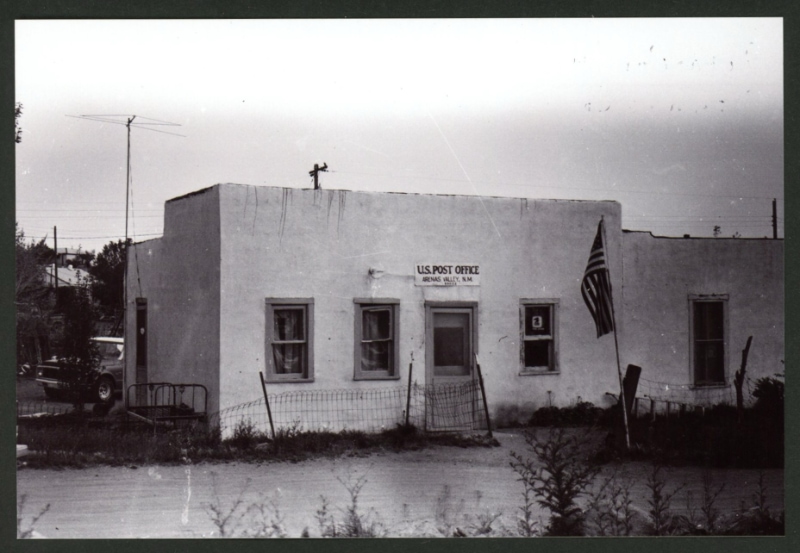
The “new” Arenas Valley Post Office was a nondescript, stuccoed structure of indeterminate age and heritage. Before it became a post office, it housed a small convenience store where my friends and I could buy pop and other snacks. One of my favourite purchases was chocolate-flavoured soda pop; I don’t recall the brand, and I never saw it again after the store closed to make room for the post office.
A simple sign above the door made clear the building’s transition from convenience store to post office. Inside were ornate mail boxes and a wicket, behind which the postmaster greeted his customers, sold stamps and money orders, and distributed letters and junk mail — very small amounts of junk mail compared to today’s flood! — to the mail cubbies. A few “WANTED” posters announced that the post office was an institution of the federal government.
Joe and Hazel Moore
I remember the new postmaster, Joe Moore, as a tall, gaunt, uneasy man, but quiet in a friendly sort of way. He and his family lived in a small house behind the post office. Joe never looked well and indeed was not well: he was apparently suffering from polio, ended up in an iron lung, and died October 23, 1952. Joe’s wife, Hazel V. Moore, succeeded him. I assume that she served as interim postmaster after his death, before being named acting postmaster on June 3, 1953, and postmaster just 26 days later.
Hazel, a thin slip of a woman with dishwater-blonde hair, was mother to three waif-like little kids, Jimmy, Charlie, and Suzy. Hazel always seemed tired and sad, but she was a kind woman who patiently endured the limitless curiosity of my friends and me about the larger world that she represented.
In those days, we were taught to address women according to their marital status, which in Hazel’s case would have been “Mrs. Moore”. If she hadn’t been a married woman, we would have said “Miss Moore”. But my friends and I were so comfortable with her, and she with us, apparently, that we automatically called her Hazel whether we were talking about her or addressing her directly. (My mother’s given name was Hazel, too, but my friends would never have dreamed of addressing her as anything but Mrs. Ingraham.)
My friends and I assumed that Hazel took special interest in all of our activities. Danny Sanders and I once proudly entered the post office to show her our latest prize, a large, angry bullsnake captured in our endless hunt for animals which might have become pets but never seemed to like the idea. Hazel’s response shocked us, and probably the snake, too: She screamed a full-throated, adrenalin-charged, phobic, death-defying scream. Danny and I retreated with our snake, alarmed that our invasion of the post office might have killed Hazel.
Hazel’s daughter, Suzy, told me in an email several years ago that Hazel, who died in 1985, served for 33 years as Arenas Valley’s postmaster. When she retired, she was replaced not by another postmaster, but by an “Officer-In-Charge,” Francis M. Torres, who was appointed on January 15, 1985. The Arenas Valley Post Office was discontinued on April 20, 1987, and its mail was sent to Silver City (Postal Bulletin 21616).
By that time, the post office had been moved out to Highway 180, about two miles from Central (renamed Santa Clara in 1996). Soon after the move, the ugly old building was demolished and replaced by a double-wide trailer.

In eighth grade at the Elementary Laboratory School, operated for the benefit of student teachers at New Mexico Western College (now WNMU, Western New Mexico University), I wrote a descriptive paragraph about the Arenas Valley Post Office for my teacher, Miss Inez Rhodes. My wife, Susan, recently re-discovered the paragraph in an old scrapbook; coincidentally, it is dated October 4, 1956, her 11th birthday.
Miss Rhodes awarded me an “A” for content and an “A-” for “mechanics” — spelling, grammar, punctuation, layout, and, I suppose, my barely readable penmanship. If you wish, you may try to read the original in a larger image, but the following transcription will be kinder to your eyes:


Box 28
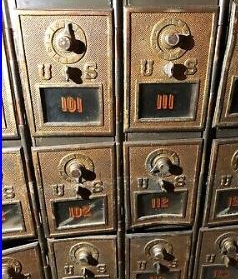
Box 28, my family’s mailbox, was one of several mail cubbies to the left of the post office’s ornate wicket. Each had a decorative, cast-metal door with a two-factor alphabetic combination lock. We unlocked it by twisting its single pointer a full revolution or more clockwise to N, then counter-clockwise to C. Oh, to still have such simple passwords! Once, when Hazel was absent, I opened Box 28 and reached into and through it to see if I could pull mail out of other, nearby boxes. I could! Easily! I didn’t take a thing. I didn’t even look at my potential “loot” — I was no thief, except in fantasy.
Stamps at the wicket
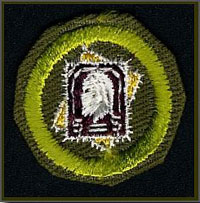
I joined the Boy Scouts of America in the early 1950s, around the same time that two boys about my age, sons of one of my dad’s business associates, introduced me to stamp collecting. I soon became a regular customer at the post office, eagerly anticipating the release of new stamps and hoping to earn a stamp collecting merit badge (which I did).
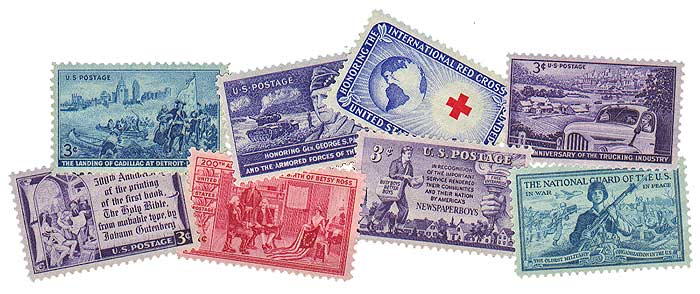
Hazel played her role perfectly. From behind her wicket, she would show me new issues and would sort through panes of stamps to search for perfectly centred copies. Hazel, unlike most of today’s so-called “postal clerks,” actually understood what collectors wanted and always separated stamps from their sheets with surgical precision. I usually bought single stamps for my Ambassador Album for Stamps of the World and plate blocks of four, which I stored in a small stock book with pages consisting of glassine pockets.
Stamps on approval
As a Boy Scout, I received the monthly Boys’ Life magazine, now called Scout Life. When each new issue arrived, I skipped the articles and the other ads and went straight to the classifieds, which always included a full page or more of ads for stamps on approval.
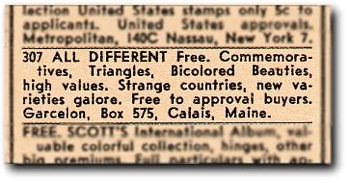
I spent most of my allowance — 50 cents a week — on approvals from such companies as Jamestown Stamp Company, H.E. Harris, Garcelon Stamp Company, Kenmore, and Gadsden Stamp Company.1 I soon learned that the Gadsden company was “headquartered” in a bungalow just a block or two away from my grandparents’ almost identical bungalow in Hurley, a company town owned by the Kennecott Copper Corporation, and that its owner was also the president of the Hurley Stamp Club, which was the first stamp club I ever joined.
The business model for approvals was based on trust. The approval dealers mailed inexpensive stamps to their clients, usually in short sets without the high-value stamps, packaged in printed glassine envelopes or attached to sheets with stamp hinges. The collector selected the stamps he or she wanted and returned the remainder along with payment. It was an honour system, one that most collectors upheld, although I must confess that I did not always promptly return the stamps I didn’t want and payment for the stamps I wanted to keep.
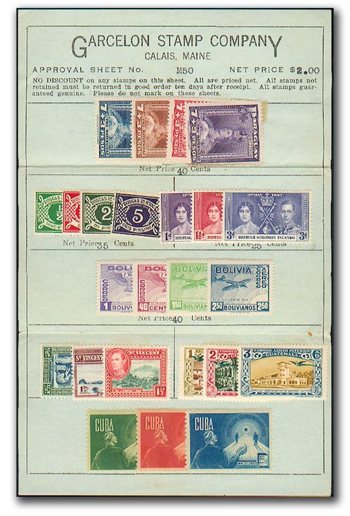
The approval sheet at the right came from the well-known Garcelon Stamp Company, located in St. Stephen, New Brunswick. Much of Garcelon’s business came from American customers, so its approvals for them were mailed from Calais, Maine, just across the St. Croix River from St. Stephen. At one time, Garcelon employed 150 people who sent approvals around the world. Most of the approval companies that sent approvals by mail are long gone, but a few still exist. Today, most stamps are sold by companies who rely on high-quality scanned images to interest potential buyers.
Not long after I started collecting stamps, I realized that some stamps reflected my most memorable experience to that time, namely my first airplane ride. Shortly before my family moved to New Mexico, my Dad arranged for Helen and me to have a flight in a Piper Cub over Savona. I have been nuts about airplanes ever since, so it’s not surprising that one of the most exciting selections of approvals I received included a mint set of eight Hungarian airmail stamps, issued in 1954 and picturing various aircraft, model airplanes, and a parachutist. When I saw that the set included a stamp showing two MiG-15s flying in formation, I couldn’t not purchase it.

After my family moved from Arenas Valley to Silver City in 1957 and I started high school, stamp collecting faded into the background of my life, replaced by a growing interest in girls, photography, girls, some of my classes (band, science, geometry, journalism), and girls. Military service in Vietnam, university, marriage, husbandhood, fatherhood, emigration to Canada, and my career as a teacher put more and more distance between me and stamp collecting until 1980 or 1981. That was when teachers in my elementary school — Wildwood School in Prince George, British Columbia — were “encouraged” — coerced? — into sponsoring extracurricular activities.
Thumbs down for coaching, thumbs up for stamp collecting
Our principal, Geoff Eacott, suggested that we teachers might consider coaching a basketball or baseball team. The last thing I wanted to do was to sponsor any team sport. I’d had an aversion to locker rooms and “team spirit” since elementary school, but I had an idea for something new at the school: I would start a stamp club!
I soon had a room full of enthusiastic new collectors who seemed to have found their niche: They were thoughtful, academically inclined but not necessarily top students, more introverted than extroverted, and quick to learn that stamps aren’t just colourful little rectangles of paper, but are artifacts that reveal much about our world. And something that I didn’t anticipate — the students’ enthusiasm for stamp collecting reignited my own. Since my wife, Susan, and I had emigrated to Canada in 1969 and intended to become Canadian citizens, I bought a Canadian stamp album and began learning more — much more — about our new country through its postage stamps.
And then came covers…
It wasn’t long before a local stamp dealer introduced me to cover collecting. Covers — “dirty, old, used envelopes” — offer what stamps alone cannot: Every cover has a longer, more detailed story to tell.2 Its stamps or lack of stamps tells the collector how old it is, how it was carried through the mail stream, and what it might have enclosed. Hand-written or typed addresses and return addresses reveal the origins, destination, and intended recipient or recipients. Their cancellations and postmarks, penciled notations, paper type, size and condition3 of envelope, general condition, and sometimes — if you’re lucky — the contents all work together to provide detailed if incomplete histories of covers. Sometimes not much work is involved!
As you have no doubt gathered, Arenas Valley’s postmasters had a lot of time on their hands. There must have been days when no mail was delivered and no one came in to mail a letter, which explains why so few Arenas Valley covers have survived. In my 40 years of searching for them, I have found just three. They include this one. Please curb your excitement:
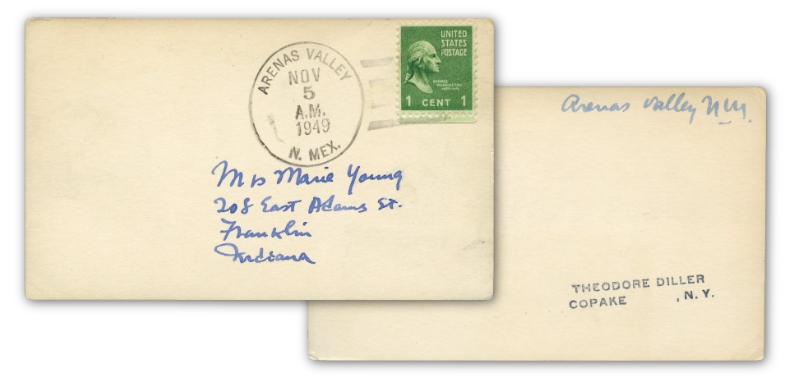
This humble penny postcard may owe its existence to marcophily, the collecting of postmarks, one of philately’s smaller specialties. The card’s recipient, Mrs. Marie Young of Franklin, Indiana, seems to have been a postmark collector. Collectors like her often obtained postmarks from distant post offices by sending a stamped, self-addressed postcard tucked inside an envelope addressed to the postmaster, with a polite request to cancel the stamp and drop the card in the mail. Small-town postmasters usually obliged, and Arenas Valley’s, as we’ve seen, had time to spare.
If that’s what happened here, the postmark was probably struck by Mrs. Harper, who was still Arenas Valley’s postmaster in November, 1949. Someone also wrote “Arenas Valley N.M.” on the back, perhaps to keep track of which card was bound for which post office. The card raises a question I haven’t been able to answer, though: who was Theodore Diller of Copake, New York, whose rubber stamp appears there? A dealer who prepared postcards like this one for paying customers? A fellow collector who traded postmarks with Mrs. Young? A club member who mailed requests on behalf of others? Perhaps a reader knows.
No cover can reveal its entire provenance,4 but covers often include unexpected elements that alert the collector to a potentially interesting story. That’s the case with one of the three Arenas Valley covers in my collection, sent by an M.J. Fell to the Gulf Oil corporation in Houston in the late 1950s or in the 1960s. When I purchased the cover for a few dollars from an American dealer, I had no idea who M.J. Fell was or why he or she was mailing a corporate letter to Gulf.
Return to NEW MEXICO CONNECTIONS
-
The Gadsden Stamp Company was no doubt named after the Gadsden Purchase of 1854, the treaty between the United States and Mexico that expanded the U.S. territory by 29,640 square miles in present-day Arizona and New Mexico. It was motivated by the desire for a southern transcontinental railroad and resolved some border disputes. ↩︎
-
Stamps, of course, also have stories to tell. Their subjects, their colour or colours, their size, the number of perforations they have on each side, the type of paper they were printed on, their watermarks, the printing technology that was used to print them, printing errors, their original price, their dates of issue and valid use, their purpose, their rarity, and their cancellations all reveal at least some of their history and often the history of period in which they were issued.
What individual stamps cannot often reveal is the identity of the people who bought them, why people decided to buy one particular stamp rather than another, and why, in the case of mint stamps, they were never used. Blurred, lightly struck cancellations usually leave the collector in the dark about everything regarding their use. ↩︎
-
In stamp and cover collecting, condition is everything. Common, damaged stamps and covers have little value. Uncommon or even rare stamps may have considerable value, if damage is light. Significant damage transforms them into fodder for the recycling bin.
In an inversion of the practice that forces prices higher for undamaged stamps and covers, there is a class of covers called adversity covers because they have been visibly damaged or severely slowed in their passage through the mail stream by plane crashes, train wrecks, shipwrecks, natural disasters, and even terrorist attacks.
I collect "crash covers” — adversity covers that had the misfortune of being in civilian airliners that crashed.Curiously, the most expensive crash covers are those with severe damage (as long sufficient to their identity remain). It's hard to believe but a badly damaged cover from a major air disaster can sell for hundreds or even thousands of dollars. ↩︎
-
Provenance refers to the origin or source of an object, artwork, or document. It describes the history of ownership or custody of an item, and is used in the context of authentication or verification of an item's authenticity or legitimacy. ↩︎