Box 28, Arenas Valley, NM — A tiny country post office played a big role in my youth (Part 3)
M.J. Fell posts a letter in Arenas Valley
It could not be more clear: A cover sent to Gulf Oil in Houston by an M.J. Fell was posted in Arenas Valley. The proof is seen in The Arenas Valley duplex cancellation that cancels the 1-cent stamps affixed to the cover.
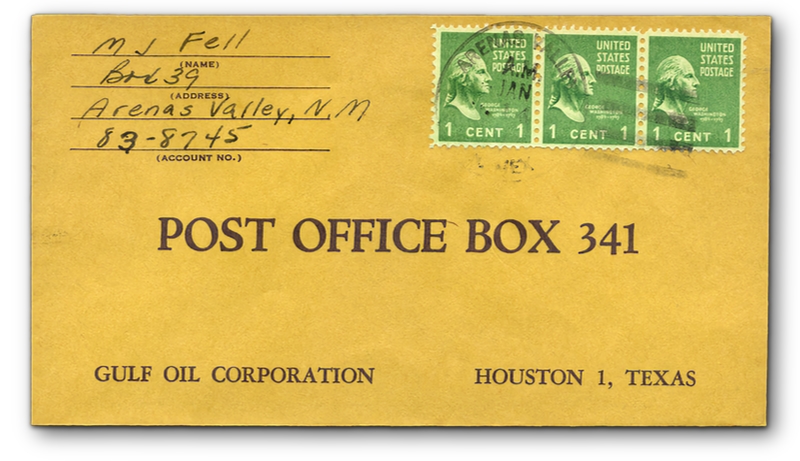
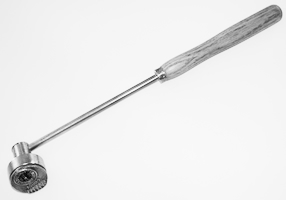
Duplex cancellations consist of two sections, a circle-date stamp (CDS) that includes the name of the post office, its location, and the date and sometimes the time of posting, and a “killer” or series of straight or wavy lines intended to deface the stamp. Ideally, only the killer defaces the stamp while CDs is imprinted on the envelope so it will be readable. The cancellation on M.J. Fell’s cover is an f-type 4-bar cancellation, used in American post offices from the 1930s into the 1960s.
In the case of M.J. Fell’s cover, Postmaster Harper didn’t give the stamp a solid, square whack with her cancellation hammer, with the result that the year was missed. It’s actually unusual for hand-cancelled stamps on or off cover to have fully readable cancellations. I suspect that the reasons are dual: It had to have physically demanding to cancel many stamps at a time, and those cancellation hammers don’t seem to be very ergonomic. Besides, in the 1950s, no one but stamp collectors seemed to care whether a CDS cancellation was readable.
Because the Arenas Valley Post Office served a small village, relatively few covers were ever posted there, and few of those have survived. I have only three in my collection, and two of them are philatelic.1
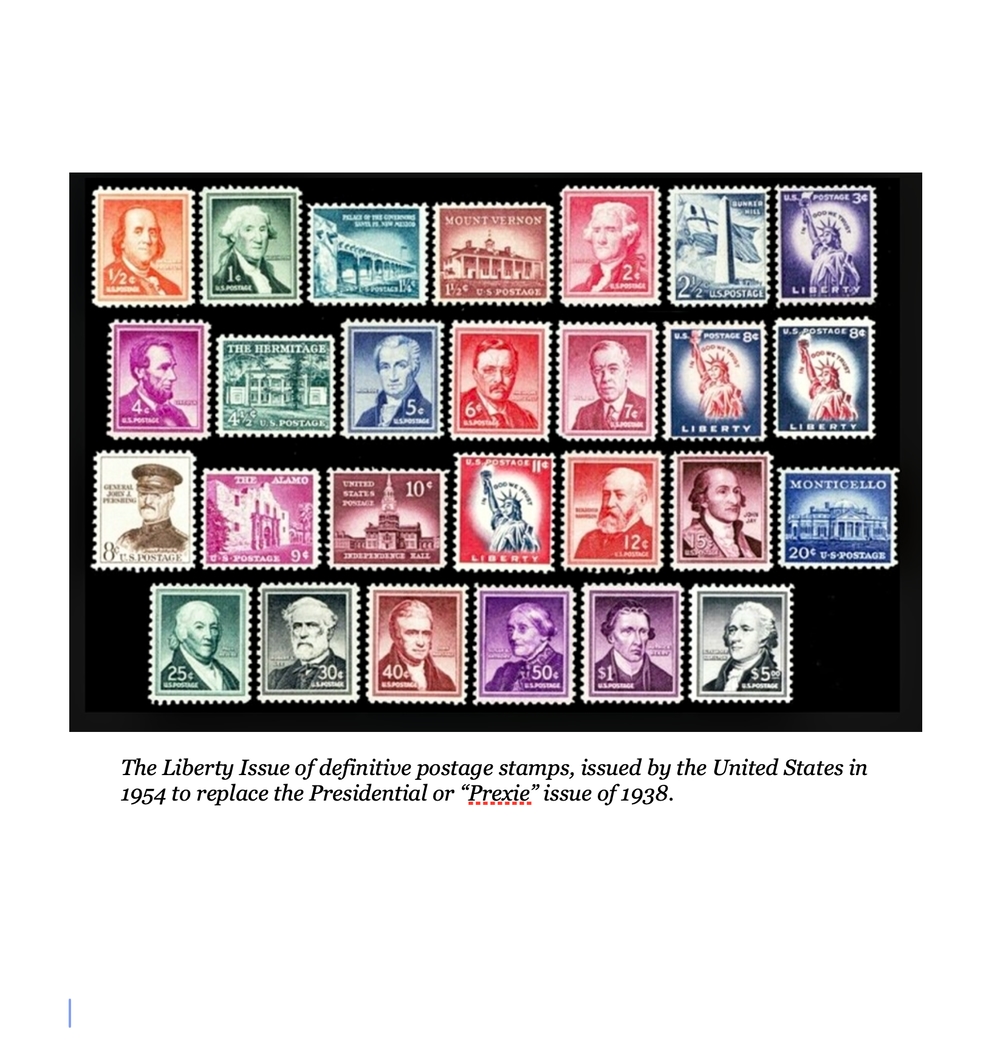
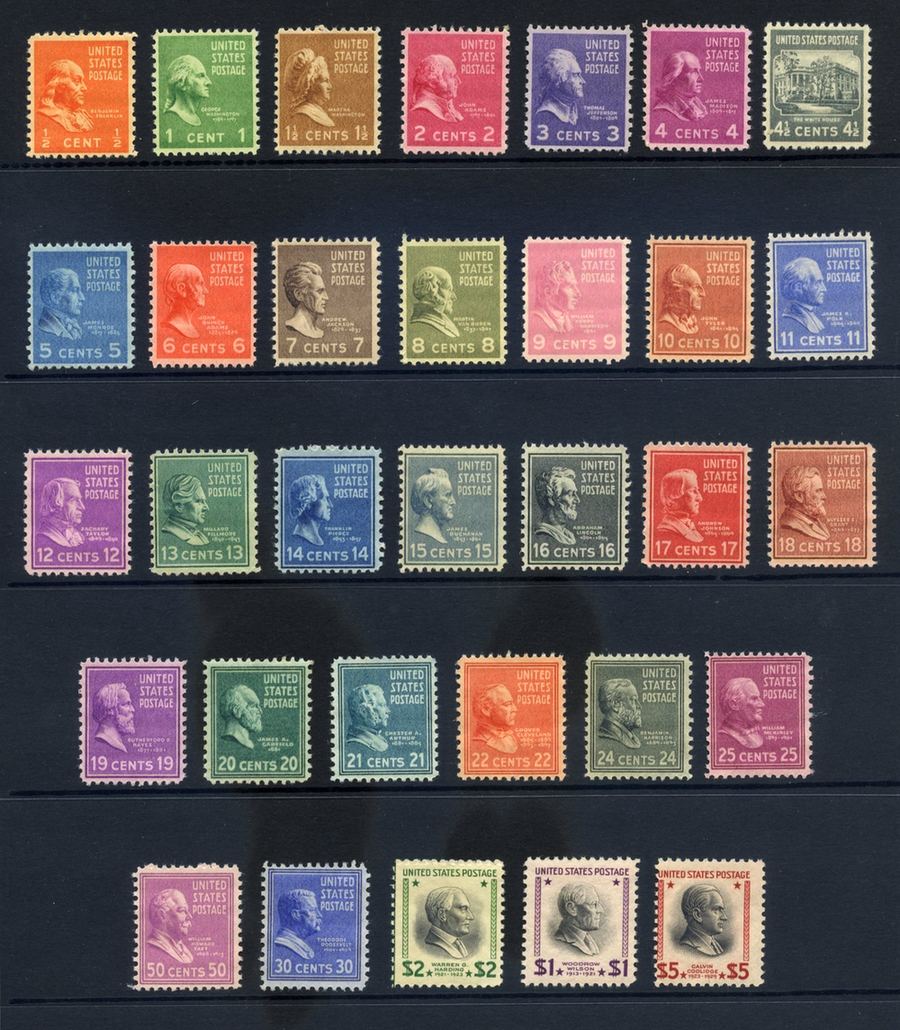
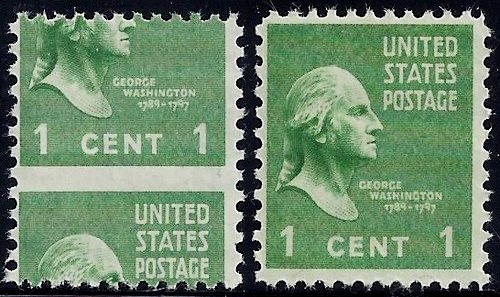
The stamps affixed to the cover are included in the Presidential Issue of definitive postage stamps,2 generally called the “Prexies” by collectors. They were issued in 1938 and only replaced by the Liberty Issue in 1954, so it’s a bit puzzling that the cover to Gulf was franked by the 1-cent Prexy stamps. When new series of definitive stamps are issued, the post office doesn’t generally withdraw older stamps from sale. The Arenas Valley Post Office could have had Prexies for sale for several years after they had been replaced by the Liberty Issue, or M.J. Fell might have had a stock of the older stamps on hand. (American postage stamps remain valid for postage whenever they were issued, right back to 1847 although it would be foolish indeed to use many of the earliest issues for postage. A mint copy of the first American postage stamp, picturing Benjamin Franklin, sells today for several thousand dollars, assuming you can find one.)
Pat and Don Fell provide provenance
So who was M.J. Fell? fellow member of the on-line stamp club StampoRama suggested that a Google search for the surname “Fell” in Silver City might turn up a family member. It did, and I was able to contact Fell’s daughter-in-law, Pat Fell, a semi-retired real estate broker who lives in Silver City, about five miles west of Arenas Valley. Pat told me in an email that M.J. Fell — Marvin John Fell — moved from Texas to Arenas Valley with his wife, Bettye Jean, and sons David, age 6, and Don, age 3, in 1955.
The value of artifacts is always enhanced if their owners can show details of the items’ provenance. Don, who would one day marry Pat, joined her in answering my questions and explaining his family’s history, and good portion of the cover’s provenance.
Pat and Don explained that Marvin, following his family’s move to Arenas Valley, worked for the Kennecott Copper Corporation, which at that time operated the world’s largest open-pit copper mine at Santa Rita and a smelter at Hurley; for a time, Marvin was a brakeman on the Atchison, Topeka, and Santa Fe Railway (AT&SF) trains that transported ore between Santa Rita and Hurley.


Later, Marvin worked for a car dealership in Silver City. He never had far to go to work. Santa Rita is about seven miles by road east of Arenas Valley, and Hurley some nine miles southeast; Silver City is five miles west of Arenas Valley. In 1957, Marvin purchased the Silver Heights Gulf gas station, located at 501 East Silver Heights Boulevard, from his good friend Charlie Tutor. Marvin would have posted the cover to the Gulf corporation sometime between 1957, when he still lived in Arenas Valley, and no later than 1963, when he might have visited a friend or friends in Arenas Valley. By 1963, he was hired by ENCO to operate a new gas station in Silver City. Four years later, Marvin accepted a job with the the newly reopened Phelps Dodge Corporation copper mine at Tyrone, five miles south of Silver City.
Marvin eventually left Phelps Dodge, during a shutdown (a common occurrence in the mining industry), and moved to Morenci, AZ, where he was hired as a full time preacher at the Church of Christ. On January 27, 1985, Marvin had a heart attack and died in bed.
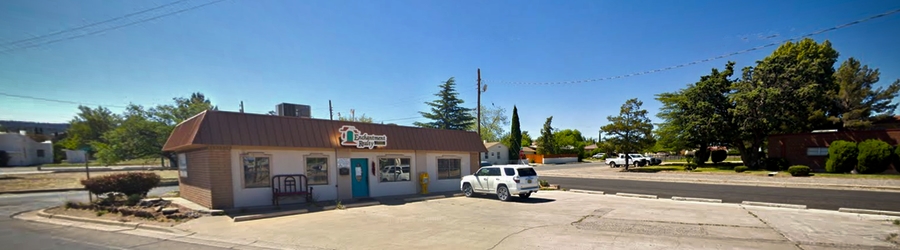
The building that had housed Marvin’s Gulf gas station was renovated in 1980 and eventually became the home of Stiles Real Estate, owned by real estate brokers Don and Laura Stiles. It is still serving the real estate industry, under new owners, as Enchantment Realty, a name borrowed from New Mexico’s state slogan, the “Land of Enchantment”.
The Arenas Valley school bus
One of the interesting realizations I had in researching this web page was that I almost certainly rode the school bus to and from school in Silver City with Donny’s older brother, David, but I was five years older than David and would have seen him as just a “little kid” not worthy of the attention of the older, “sophisticated” boy that I imagined myself to be.
The school bus that David and I rode played a significant role in my life. I came to know the bus driver, “Chink” Tony, well. (There was, by the way, no racist condescension in his nickname — everyone called him “Chink” without prejudice, probably just because of the slightly Oriental “slant” to his eyes.)
Chink brooked no bad behaviour on the bus. I remember once when one of the boys was misbehaving on the ride home after school. The boy ignored Chink’s first warning, but there wasn’t a second one: When the boy continued misbehaving, Chink pulled off the road about a mile from our bus stop, opened the door, and ordered him to get off the bus and walk! Chink would never get away with that in these more-permissive times. Unfortunately.
I have litle doubt that Chink remembered at least one incident involving me. One school day, shortly after climbing onto the school bus and moving to the back to be with my friends, I realized that something wasn’t quite right. What wasn’t right was the feeling that there were creepy crawlies inside my clothes. There were creepy crawlies inside my clothes! Large, vicious red ants! I had been standing, cluelessly, on a red ant hill while I awaited the school bus. A not-insignificant number of them had crawled up my legs, even into my underpants and undershirt, and were stinging me. The school bus was approaching my house when I raced down the aisle and yelled to Chink that he had to let me off! He stopped, opened the door, and I raced into the house, tearing my clothes off as I ran. Mom was surprised to see me, but was soon spreading soothing calamine lotion on my ant stings, getting some fresh clothes for me, and driving me to school.
One incident on the school bus proved that I was no Romeo. Around grade five, I “fell in love” with Eileen Neil, an attractive high school girl and a friend of my sister, Helen, who is four years older than me. I was “flirting” with Eileen as the school bus approached my stop. I soon learned that flirting with “older women” was not necessarily a good idea. Eileen, who was bigger and stronger than me, turned out to be a bully who threatened to kidnap me!3
You can’t go home again…
They say that you can’t go home again, and that’s true, especially if you’ve been away from “home” so long that you can scarcely recognize it when you do manage to visit. I left home in 1962 to join the U.S. Navy, and only returned for brief visits before my parents, Mr. and Mrs. Robert M. Ingraham, died. But an old, used envelope franked with ordinary stamps has taken me back to a Silver City that will never again exist. The cover that Marvin Fell posted to the Gulf corporation in Houston facilitated my email exchanges with Donny and Pat Fell, both of whom provided useful information about their immediate family’s history, and specifically about the cover. It seems that you don’t have to live next door to people, or even in the same country, for them to seem like friendly, helpful next-door neighbours!
-
Philatelic covers are envelopes that are created by or for stamp collectors. Through the use of particular stamps, labels, and various designs on the front of the envelopes that are added by hand, by rubber stamp, or by printing press, they may commemorate a particular event, a custom, or a situation. ↩︎
-
Definitive stamps are usually small-format stamps intended for use over a period of years, and often feature portraits of famous people or subjects pleasing to people — flowers, trees, animals, architecture, and scenes specific to the country of origin. Commemorative stamps, generally larger than definitive stamps, are released for a limited period to honour a specific persons, events, anniversaries, and places, or pictorial stamps, also generally larger than definitive stamps, which feature images or designs representing specific themes, events, or subjects other than individual people. ↩︎
-
In 1967, when I was a sophomore student at the Kansas City campus of the University of Missouri, my short story about my brief “romance” with Eileen, The Crush, was selected for publication in Number One, a literary journal published by the university’s English department. ↩︎