Christmas tragedy at Prestwick (Part 6)
The Queen commends a fireman for bravery
Stewardess Margaret Coogan’s death was probably inevitable, but Leading Fireman James Smith of the Prestwick Airport Fire Service did his best to prevent it. Smith was on duty when BOAC Stratocruiser G-ALSA crashed at Prestwick, and was able to free the severely burned stewardess from the aircraft’s wreckage.
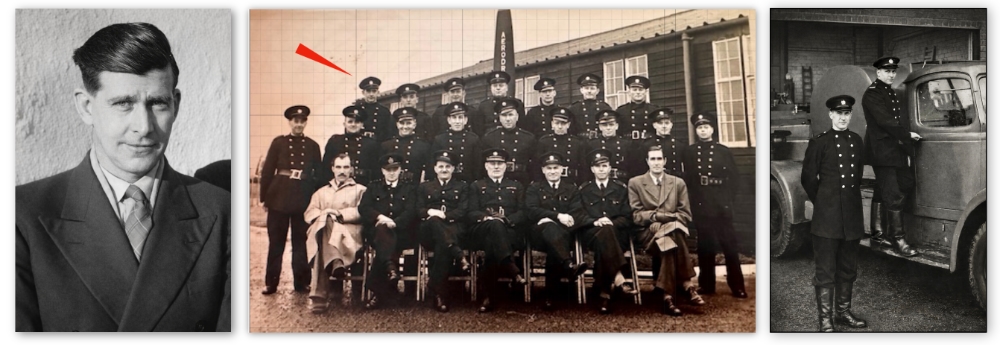
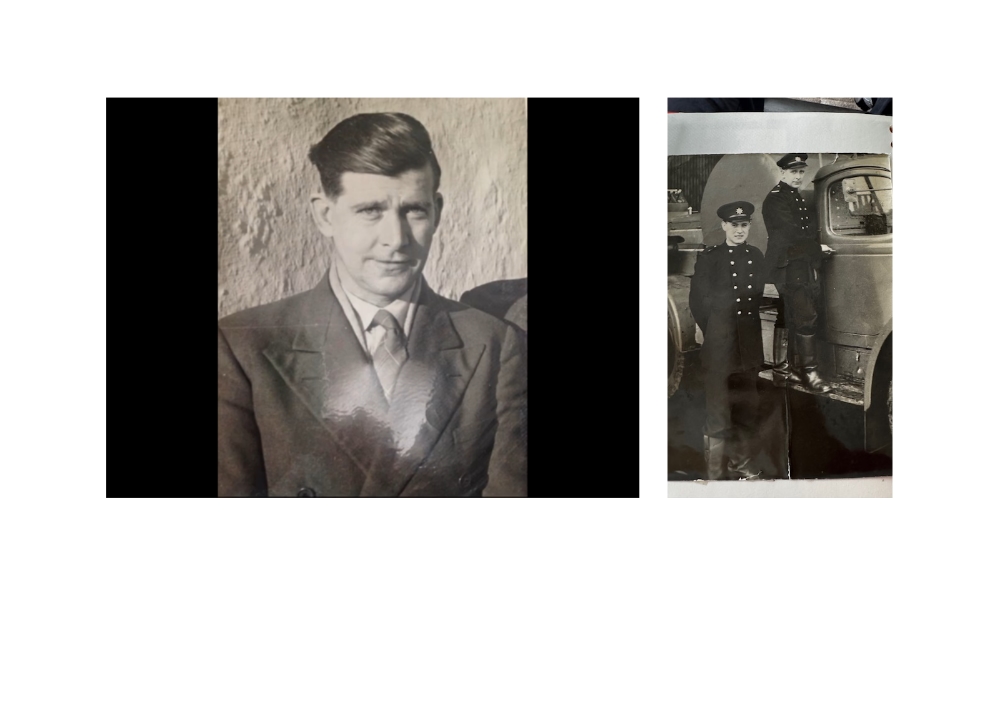
Coogan, suffering smoke inhalation and first-degree burns over much of her body, died at Prestwick Airport before she could be taken to hospital. Smith's selfless attempt to save her life did not go unnoticed. On December 26, Britain’s national newspaper, the Sunday Express, expressed praise for Leading Fireman Smith in an all-caps in its story about the crash: HE HAD NO SPECIAL PROTECTION, AND PETROL TANKS WERE EXPLODING, BUT BEFORE THE CABIN FINALLY BECAME ENGULFED BY FLAMES HE THREW OPEN A HATCH AND DRAGGED CLEAR MISS MARGARET COOGAN, THE STEWARDESS, OF HOLYLAKE, CHESHIRE. SHE WAS ALIVE, BUT DIED LATER.
On May 17, 1955, Leading Fireman James Smith’s name was published in The London Gazette, the United Kingdom's official journal of public record, which has been in continuous publication since 1665. For readers unfamiliar with British practice, to be gazetted means to have one's name and the relevant act formally entered into The Gazette, which serves as the Crown's permanent, public register of honours, appointments, and official acts. An award has no full official standing until its publication occurs. Being gazetted is, in effect, the moment the recognition becomes real and permanent. It has often been used to recognize acts of bravery and self-sacrifice by both civilians and soldiers in wartime.
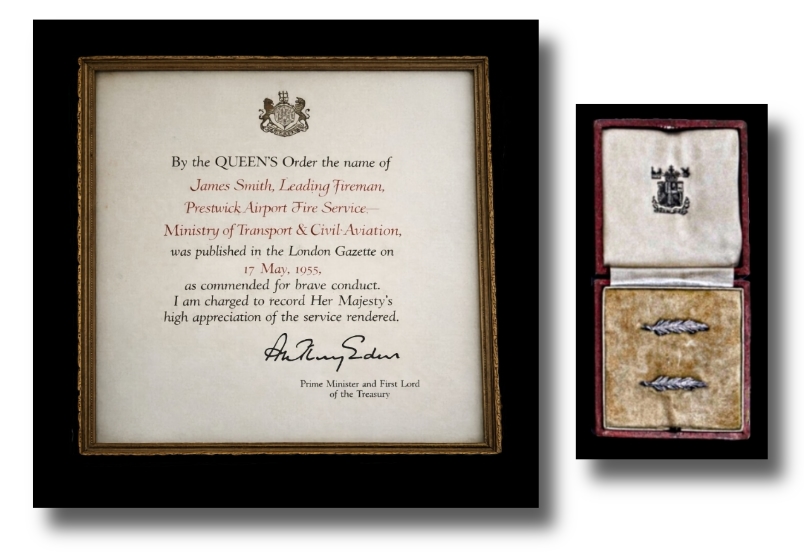
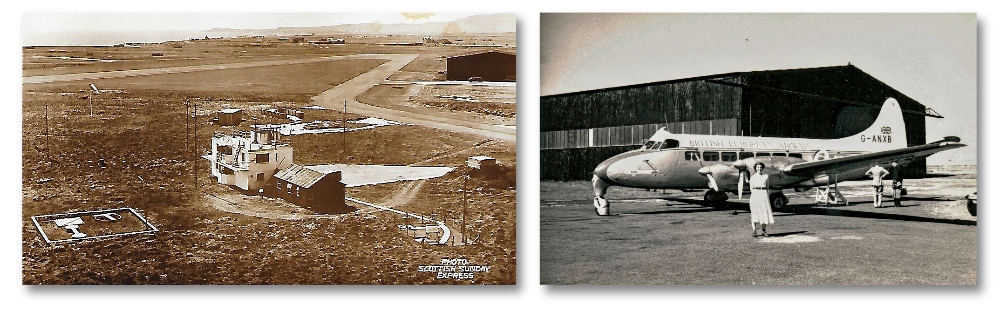
Following the crash of BOAC G-ALSA at Prestwick, and almost cmetertainly because of his James Smith’s acknowledged bravery and leadership of the Prestwick Fire Service at the time of the disaster, he was eventually promoted and relocated to command the fire service at Tiree, the westernmost island in Scotland’s Inner Hebrides islands. James’ wife Annie, daughters Joan and May, and son James remained in Kilmarnock after James was posted to Tiree, but were considering moving there.

About 700 residents were living on Tiree in 2025. It’s not a big island. While it measures a bit more than 30 square miles, a brisk walk could take you from white-sand beaches at its southwest end to white-sand beaches at the northeast end in about two hours.Walking across the island south to north at its widest point take only an hour. The postcard was obviously posted by a holidaymaker named Cathie: “Having a good holiday,” she writes. “Weather has been lovely. She notes that she and her friend Tina are going to listen to “the Pipe Band,” and that “There are a lot of visitors on the island." ~ Bob Ingraham’s collection
And then, another tragic death
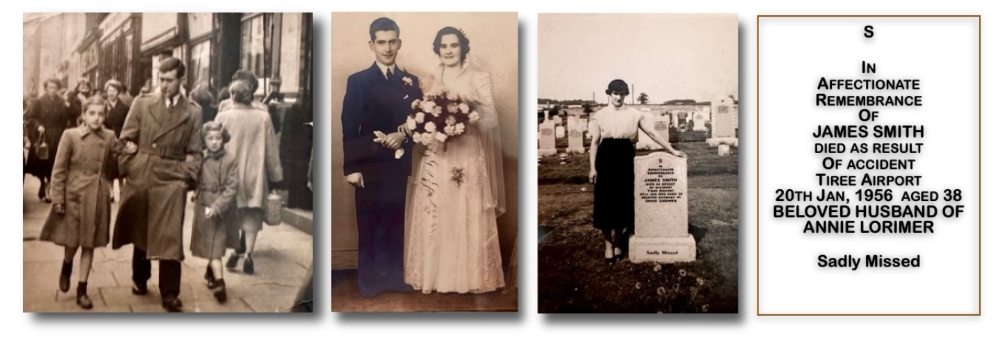
On January 20, 1956, Smith was at Tiree Airport when a violent windstorm blew up. Smith organized fellow fire fighters to tow a small airliner to safety. The Oban Times, covering the news from Scotland’s West Highlands, Islands, and Argyll, reported under the headline GALE KILLS TIREE AIRPORT EMPLOYEE — Hanger Door Ripped Off that James Smith “had only been on Tiree a few weeks”. The following story explained that Smith and the other Tiree firemen were working on a small airliner, a de Havilland DH.114 Heron, which had been forced to return to the island after taking off because because of a mechanical problem.
“As the disabled craft was being towed towards one of the hangers for servicing by members of the crash crew a sudden 80-miles-an-hour gust of wind ripped off one of the hanger doors, which were open, and hurled it towards the men like a giant hand. Mr Smith, who was running to warn his colleagues, was caught in the path of the huge door which sliced across the tarmac and came to rest under the wheels of the towing tractor 60 yards away.”

William Wells, who lives in Kilmarnock, 110 miles southeast of Tiree, is James Smiths’ grandson. In 2016, William and his son visited Tiree where, remarkably, they met the airport employee who was driving the tractor that was pulling the Heron airliner into the hanger to protect it from the storm. He told James and his son that British soldiers stationed near the Tiree airport had been called to help remove the heavy hanger door from Smith, who was still alive but bleeding heavily; a bolt that that connected a corrugated steel sheet and the frame of the hanger door had pierced his skull. Smith might have lived had the storm not delayed a medevac flight to hospital in Glasgow.

In the cargo — Diamonds!
Donald Fraser, who lives in Old Kilpatrick, a few miles west-northwest of Glasgow, wrote to provide the intriguing information that of uncut diamonds valued at more than £1 million were thought to have been aboard the aircraft. He said that Scotland’s Daily Record & Sunday Mail and the Glasgow Herald ran stories saying that the diamonds were contained in postal packages along with 250 other bags of mail that were also on board.
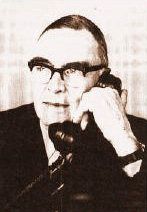
An airline detective, Donald Fish, was in charge of B.O.A.C. security at Prestwick at the time of the crash. He writes about the diamond incident in his book, Airline Detective (Collins, London, 1962). Only about 300 diamonds were recovered, although the authorities removed all the topsoil from the crash site as it was thought that the rescue workers may have inadvertently trod on some diamonds, forcing them into the soft earth. The search for the lost diamonds was carried out at the behest of Lloyds, which carried the insurance on them. According to a well-sourced Wikipedia page, the consignment of diamonds, in 40 separate parcels, was worth “only” £900,000; 90% of the diamonds were recovered." Donald Fraser further noted in his e-mail that the story of the crash was in the news from the date of the crash, Dec. 27, 1954, through early January of 1955, but then was pushed off newspaper pages by the march of daily events.
Final Note
In 1954, flying across the Atlantic in civilian landplanes — as opposed to the giant seaplanes of the 1930s and 1940s — was becoming commonplace. Military transport and bomber pilots — among them Captain William L. Stewart, BOAC Stratocruiser G-ALSA’S pilot at the time of its crash at Prestwick — had pioneered the routes over the course of the war; the first Trans-Atlantic flights by civilian aircraft — most of them converted military planes — took place almost before the sounds of gunfire had faded away in Europe.
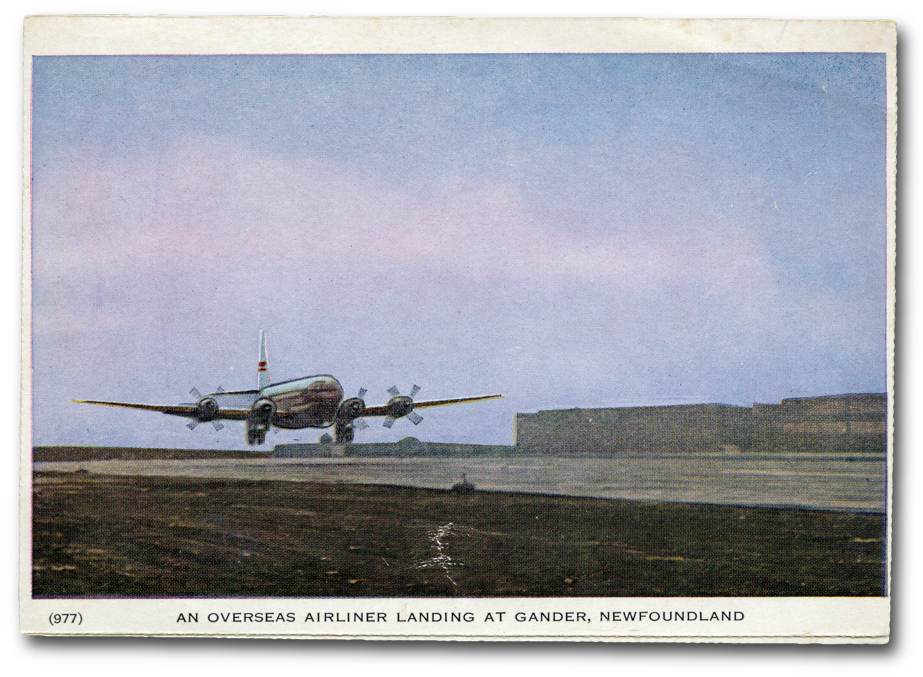
These early, post-war flights between Europe and North America were not the non-stop, globe-straddling flights of later years. The big propeller-driven airliners of the 1950s may have been more romantic than today’s jets, and the food and and the service were a lot better, but they weren’t very efficient: they guzzled fuel at prodigious rates and they routinely had to stop to refuel at Prestwick, at Shannon, Ireland, and at Gander, Newfoundland. If it had not crashed at Prestwick, the G-ALSA would probably have followed this same route on its way to New York City.
The Christmas-morning crash at Prestwick was but one of the many disasters suffered during the development of modern commercial aviation. In fact, the Prestwick crash was just one of 19 airliner accidents around the world in that month alone; in addition to the 28 people killed at Prestwick, at least 134 people died in 18 other airliner crashes (records of fatalities are unavailable for some accidents). The introduction of jet engines, far more reliable than piston engines, helped to make airliners the safest mode of transportation in history.
Go to the Ephemeral Treasures home page